From 28 May to 28 June 2024, Gdańsk became a site of intensive artistic exchange as part of the international residency programme of Turning the Tide. Over the course of one month, artists, curators, producers, scientists, and cultural practitioners came together in a carefully structured process designed to support artistic research at the intersection of water, climate, urban space, and social imagination. The residency was not limited to studio work or formal meetings; it unfolded through movement across the city, encounters with its institutions and infrastructures, and a gradual immersion in the cultural and environmental complexities of Gdańsk.
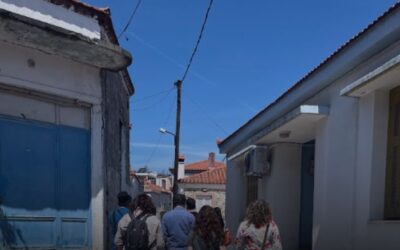
Even before the artists arrived, the residency had already begun to take shape. A few days ahead of their journey, the residents received a preliminary residency plan prepared by the team of the Institute of Urban Culture. This document included mandatory meetings as well as a selection of locations proposed for individual exploration or shared visits, allowing the programme to remain both structured and open. The artists were introduced to places linked to Gdańsk’s cultural heritage — the shipyard, the Old Town, bastions, museums, and galleries — alongside natural areas such as the Tricity Landscape Park, Sobieszewo Island, and urban parks, as well as sites related to the city’s water management, including the Radunia Canal and local retention reservoirs.
To support independent research and help the artists navigate the city on their own terms, the team also prepared an extensive seventeen-page guidebook dedicated to Gdańsk. More than a practical handbook, it functioned as a curatorial tool. Alongside transport information and urban orientation, it offered descriptions of local attractions, a mapped trail of public art, links to city reservoirs, and information on natural areas of special significance. The guidebook framed Gdańsk not only as a city to visit, but as a layered territory to read, interpret, and respond to artistically. This carefully prepared environment was supported by a clearly defined creative team.
Administrative coordination was overseen by Natalia Cyrzan, who managed contracts, planning processes, and ongoing communication with partners. Curatorial guidance was provided by Maja Murawska, who shaped the residency plan, worked directly with the artists, and facilitated dialogue between them and local cultural, artistic, and scientific communities. Production was led by Joanna Weltrowska, Martyna Krefta, and Sandra Żbikowska, each responsible for supporting the development of specific artistic works and helping guide the final stages of production. Promotion was handled by Dorota Szulc, who ensured the visibility of the residency through the Institute’s website and social media channels. The official kick-off meeting took place at the Urban Culture Institute in Gdańsk and marked the beginning of a shared process of introduction, orientation, and exchange. Curated by Maja Murawska, the session brought together the participating artists — Robyn Woolston from Scotland, Katarzyna Piórek from Sweden, and Eva Andronikidou from Greece — along with the production team. The meeting established the tone of the residency: collaborative, exploratory, and responsive. The artists presented their initial concepts, with Robyn Woolston arriving with the most fully articulated proposal, including leaflets she intended to distribute across the city in order to draw attention to the gradual flooding of parts of Gdańsk. The other artists described their directions more broadly, emphasizing the need to first encounter the city and understand its atmosphere before defining their final approaches. Production partnerships were then assigned, and the artists were introduced to the Institute’s spaces, including possible venues for future presentations and areas available for day-to-day creative work.
In the days that followed, the residency deepened through a sequence of meetings that opened different perspectives on the city. One of the first key conversations took place with Piotr Lorens, Acting Chief Architect of Gdańsk and Head of the Department of Urban and Regional Planning at Gdańsk University of Technology. During an hour-long meeting, Lorens introduced the artists to the specific challenges of spatial planning in Gdańsk, especially in relation to climate change, housing pressures, and contested decisions regarding development near waterways. His presentation created space for difficult but necessary questions about the future of the city and the political choices that shape its environmental resilience. For the artists, this encounter offered a direct insight into the tensions between planning, ecology, and urban life.
A few days later, the group visited NOMUS, a branch of the National Museum in Gdańsk dedicated to contemporary art. There, curator Aleksandra Grzonkowska introduced the artists to the complex history of the building and its broader context within the former shipyard area. Her account moved across different periods of the site’s life: from industrial zone to unofficial artistic enclave, then foundation space, and finally museum. The visit was enriched by a conversation with artist Jakub Bąkowski, whose practice bridges art and science and who shared examples of his research-based projects from places such as Alaska, Svalbard, and the Amazon. What emerged from the five-hour meeting was not just institutional knowledge, but a wider reflection on how artists might work with climate, place, and community in ways that are both intellectually rigorous and socially grounded. The discussions continued informally long into the evening in the post-shipyard district, where conversation itself became part of the residency experience.
Another important moment came during the visit to Goyki 3 Art Inkubator in Sopot. This institution, dedicated to cultural production, education, and support for creative communities, offered a different model of cultural practice — one deeply embedded in local life. Kamil Antoniuk guided the group through the historic villa that houses the incubator, tracing the story of the building and its links to local and regional history. Later, curator Katarzyna Sobczak presented the organisation’s residency programmes and spoke about the ways in which Goyki 3 builds relationships between artists, institutions, and communities. The visit extended beyond the building into the surrounding park, where the artists encountered beehives, a mini eco-garden, and the mature trees that form part of the site’s living ecosystem. This meeting stood out as an inspiring example of how a cultural institution can cultivate a strong sense of belonging and care within its immediate environment.
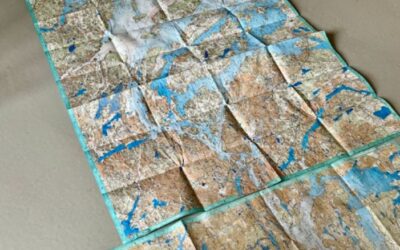
The residency’s dialogue with scientific knowledge took on a particularly important form during a meeting at the Institute of Oceanology of the Polish Academy of Sciences in Sopot. Hosted by Director Jan Marcin Węsławski, the session introduced the artists to the institute’s work on marine biodiversity, climate change, and ecosystem function. Alongside the international artists, Weronika Zalewska — herself engaged in a local Turning the Tide residency — also took part. The meeting became a rich exchange on climate science, future demographic shifts, international collaboration, and the possibilities of interdisciplinary work between art and science. For the artists, it offered a chance not only to learn about marine ecology, but also to test their own questions in relation to scientific thinking and to consider how artistic practice might communicate ecological knowledge in new ways. The methodological dimensions of the residency were expanded further through a workshop with Dear Hunter, led by Remy Kroese and Marlies Vermeulen. Bringing together the residency artists and curator Maja Murawska, the session introduced participants to the principles of cartopological research: a practice that combines ethnographic fieldwork, participant observation, and experimental mapping. After presenting their previous work, Dear Hunter invited the group into a hands-on workshop focused on mapping perceptions of selected places and objects encountered during the residency. The workshop offered not just a new research method, but a way of thinking about knowledge itself as something situated, relational, and co-created through presence and engagement. In the context of Turning the Tide, this became an especially valuable framework for artistic work in urban and environmental settings.
The city and its infrastructures remained central throughout the residency. A guided tour of one of Gdańsk’s most remarkable water facilities, the former “Old Sobieski” retention reservoir, gave participants a rare opportunity to descend into an underground architectural space usually absent from everyday urban consciousness. Built in 1911 as a reinforced concrete monolith, the reservoir impressed the group with its circular form, concentric structure, and maze-like interior. The visit revealed not only the engineering history of Gdańsk’s water systems, but also their cultural significance and their role in sustaining urban life. The inability to disclose the locations of active reservoirs for security reasons added another layer to the experience, underlining how infrastructures essential to the city often remain invisible, protected, and inaccessible. Across the month, meetings, tours, conversations, and workshops formed a dense fabric of encounters through which the artists could build their own responses to Gdańsk. Rather than delivering a single fixed narrative, the residency created a framework for multiple forms of attention: to the city’s architecture and ecology, to its institutions and communities, to its visible and hidden waters, and to the infrastructures through which climate futures are already being negotiated.
The programme balanced planning with openness, expertise with experimentation, and production with reflection. Seen as a whole, the June 2024 Turning the Tide residency in Gdańsk was not just a preparatory phase for future artworks. It was itself an active cultural process — a carefully curated environment of research, exchange, and relation-building. By placing artists in dialogue with architects, museum curators, scientists, residency organisers, and urban spaces, the programme fostered a mode of artistic practice attentive to context and committed to public relevance. In Gdańsk, art was not positioned outside the city’s environmental and social questions, but immersed within them. And it was precisely in this immersion — in walking, listening, asking, touring, mapping, and conversing — that the residency found its most meaningful form.