
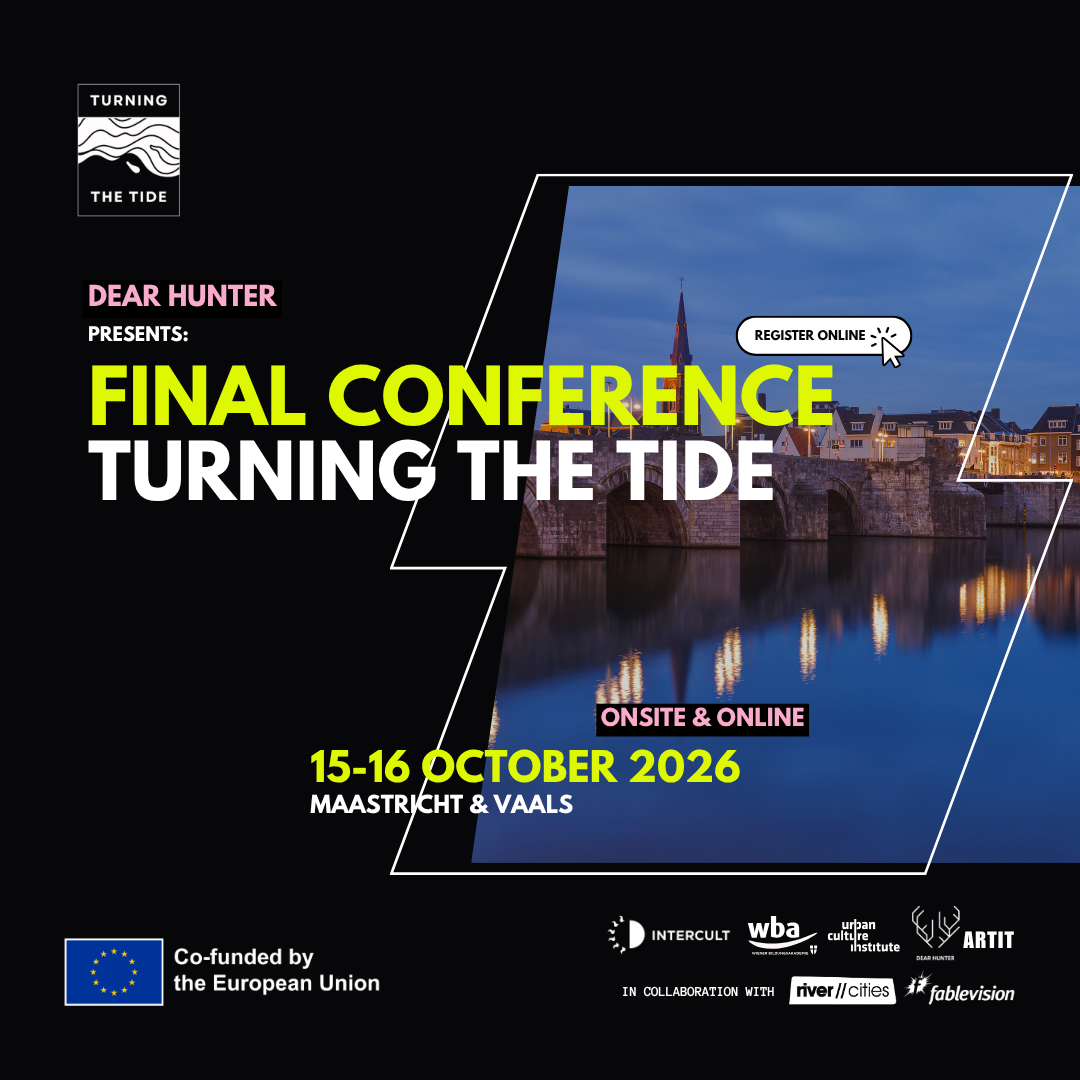
The Final Gathering: Turning the Tide Conference October 2026
In October, we’ll gather in Maastricht and Vaals to close three years of collective work. Not with a final report or a neat summary, but with open hands and curious minds.
The Turning the Tide final conference is our invitation to you: artists, residents, planners, policymakers, or anyone who has wondered how culture might help us navigate climate change together. Between 13–17 October 2026, we’ll meet across several venues in- and around Maastricht. Some days are reserved for partners only, but Thursday 15 October evening and Friday 16 October are open to the public.
What will happen?
On Thursday evening at Bureau Europa in Maastricht, we’ll officially launch the Turning the Tide Atlas, the cartopological mapping work that the partnership developed across six European locations. Dear Hunter, project partner and core contributor, will present the atlas, which contains five hand-drawn maps documenting waterfront communities from Gdańsk to Stockholm, Vienna to Evia, plus a cross-border Euregio Meuse-Rhine research. These maps are layered records of conversations, observations, and tensions gathered through months of fieldwork throughout the duration of the Turning the Tide project.
Dr. Anja Brüll from the Three Countries Park and Matthias Kindel (deputy director) from the EGTC Euregio Meuse-Rhine will join us to reflect on why culture matters when we talk about climate justice and environmental transformation.
Friday is dedicated to playful learning. Dear Hunter has designed workshops that translate their methodologies into accessible formats: sessions for exploring landscape relationships and learning activities suitable for everyone. These aren’t demonstrations but invitations to participate in the same kind of curiosity-driven work that shaped the project.
Why does this matter now?
Turning the Tide began with a question: What kind of world do we want to live in? Three years later, we don’t have a single answer. What we have is something more useful, we believe: a methodological synthesis forged through practice, not theory. Cultural planning met socially engaged art met cartopological mapping met artistic research. None of these approaches disappeared; they transformed each other.
The Turning the Tide Atlas shows us that climate challenges look different in every place. In Gdańsk, ecological concerns reconnect with industrial heritage. In Seestadt, artistic interventions strengthened public ownership of place. In Evia, communities responded to wildfire aftermath through shared recovery. In Stockholm, dialogue emerged between citizens, planners, and environmental specialists. Each location generated its own forms of impact because each place holds different realities.
We’re not presenting finished solutions. We’re sharing a framework that others can adapt. The methodology remains intentionally open and offers principles for future collaborations responding to distinctive cultural and environmental realities.
Come as you are
Whether you’re a policymaker wondering how culture fits into climate action, an artist seeking new forms of engagement, a planner looking for community-centered approaches, or simply someone who cares about the places you inhabit: we want you at the conference.
The public launch happens Thursday 15 October, 19:00–21:00 at Bureau Europa (Boschstraat 9, Maastricht). Friday 16 October offers workshops throughout the day at the same venue. Both events are free and open to all.
To register, simply declare your interest in participating here: info@bureau-europa.nl
The international partnership will be in the borderland between Liège, Aachen and Maastricht, exploring local challenges and connecting to local artists, experts and citizens, during the week preceding the public part of the conference.
Beyond the conference
After October, the atlas doesn’t close. It remains an evolving document, open to reinterpretation, adaptation, and extension. The partnerships forged over these three years continue through new collaborations, research initiatives, and European programmes. Methodologies developed here will travel wherever artists, communities, and organisations choose to build upon this foundation.
This is how lasting impact works: not by measuring what was produced, but by what we enable each other to become. Turning the Tide demonstrated that innovation emerges not through inventing entirely new methods, but through creating conditions where different methodologies can learn from one another.
Come share in that learning. Bring your questions, your perspectives, your local knowledge.
Let’s turn the tide, one last time, together!
Hourly Schedule
Thursday 15 October | 19:00–21:00 Public Launch: The Turning the Tide Atlas Bureau Europa, Boschstraat 9, Maastricht
Friday 16 October | Full Day Learning Day: Playful, Hands-On, Open to All Bureau Europa, Boschstraat 9, Maastricht & Institute of Cartopology, Vaals
- 10:00 - 12:00
- Talks
- Dr. Anja Brüll (Three Countries Park) on cross-border climate and landscape management through cultural collaboration, and Dr. Ties van der Werff (Zuyd University) on the impact of socially engaged art.
- 12:00 - 13:00
- Vegan lunch and networking
- 13:00 - 16:00
- Workshop: Mounting Mountains
- Led by Dr. Marlies Vermeulen and Remy Kroese. A hands-on workshop inviting climate-conscious observers to confront how our value systems transform environmental disasters into landmarks, forcing us to ask: when does soil become surplus, when does surplus become sacred ground, and who gets to decide?
- 16:00 - 17:00
- Conference closing and goodbyes