Most exhibitions invite you in through a name. You read who made the work, where they trained, what they have shown before, and only then do you look. The Turning the Tide Digital Exhibition asks a different first question. Not who, but where. Where was this work made, what was happening in that place when it was made, and what would it mean if it had been made anywhere else?
It is a question that sits at the heart of the climate crisis itself. Climate change is often described in numbers that belong to nowhere in particular: degrees of warming, centimetres of sea-level rise, emission targets for 2050. Yet nobody experiences it as an average. It arrives in specific streets, on specific shorelines, in the lives of specific communities, and it arrives differently each time. Over the course of the project, 42 artists (10 international artists in residence and 32 locally embedded artists, including two Ukrainian artists) worked inside that difference, across four places that each live with water and climate in their own way.
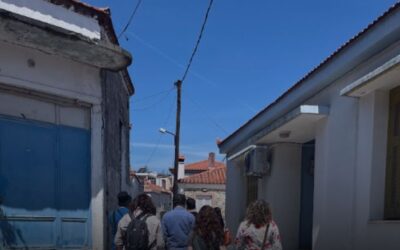
In Stockholm, the work gathered around Slussen, where the city is rebuilding its infrastructure to face rising seas and to secure its freshwater for the future, and where climate risk is something planned for, engineered and largely invisible. In Gdańsk, artists worked along a post-industrial waterfront where any conversation about ecology runs straight into shipbuilding, labour history, energy and political memory. In Vienna, the setting was Seestadt, a district so new that its sense of community is still being built alongside its streets and housing. And in Evia, climate change is not a forecast at all, but something already lived through: wildfire, flood, loss and the slow, uneven work of recovery. Four places, four very different answers to the same question of what it means to live with a changing climate.
This is where the idea behind the exhibition comes into focus. A place is never just a backdrop. It is a meeting point of histories, people, decisions, memories and, in every one of these four cases, water. Art made in a place absorbs all of that. It carries the knowledge of the residents who shared their stories, the questions raised in workshops and walks, the tensions between what a place was and what it is becoming. Lift these works out of their context and something essential goes missing. So instead of hanging them side by side on a virtual wall, the exhibition presents them as what they really are: a map of encounters between art, people and place.
The form follows the idea. Built on ArcGIS StoryMaps, the exhibition uses the map itself as its curatorial thread. Visitors begin on the introduction page, hosted on the Turning the Tide website, and choose one of the four locations. Each opens with a curatorial text on the place and the focus of its artworks, and then the artworks unfold one by one, each pinned to the spot where it came to life and presented through images, video and text: installations, performances, films, public interventions and the processes behind them. Rather than browsing a gallery, you move through a territory, following the works the way you might follow a walk through the city or the island where they were made.
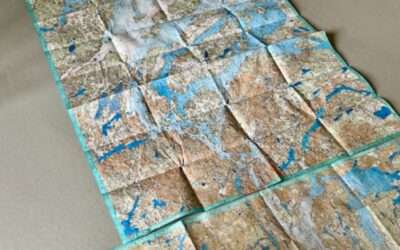
The maps deserve a story of their own. The illustrated maps that open each location were created by Dear Hunter through their method of cartopology, a blend of cartography and anthropology that treats a map not as a neutral survey but as a record of how people actually live with a landscape. Maps have always decided what counts and what gets left out. Here they work the other way around, holding the stories, rivers, memories and everyday routines that official maps tend to erase. The Cartopological Maps section brings all four together and links through to the Maps & Atlas page on the project website, for anyone who wants to read the landscapes more closely.
First presented at the project’s final conference in Maastricht, the Digital Exhibition now stays online as a lasting companion to the Local and International Urban Labs and the artists’ residencies. The best way into it is simply to pick a place and start exploring. Notice what changes when you know where a work was made. Notice what the work notices. And perhaps ask the same question of the place where you are standing right now.
Explore the Turning the Tide Digital Exhibition here!