The third Vienna Local Urban Lab (LUL 3) within the European cooperation project Turning the Tide, implemented by the Wiener Bildungsakademie, explored how water and environmental processes can be experienced through movement, education, and cinematic reflection.
Bringing together the collaborative practice of Adrian Dorfmeister and Simeon Ohlsen with the filmic work of Hans Hofer, LUL 3 created a multi-layered approach that connects body, learning, and perception.
Water as Movement: Performance in Public Space
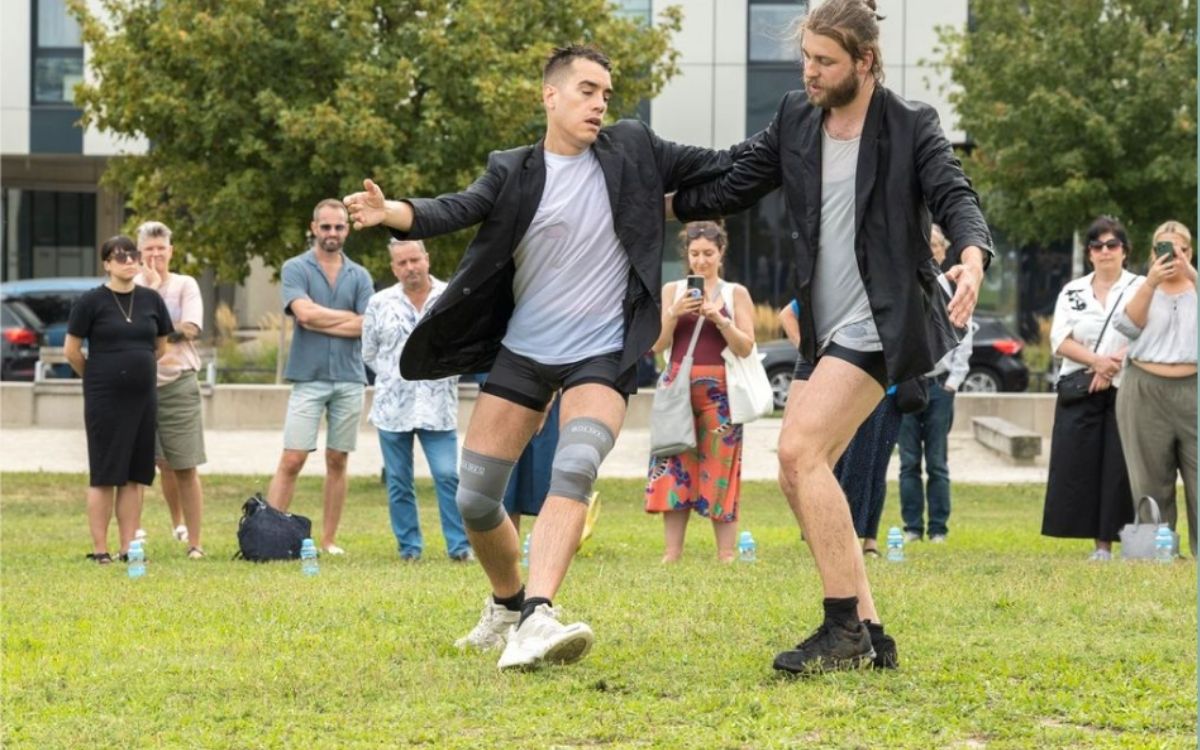
Working as a duo, Adrian Dorfmeister and Simeon Ohlsen developed a performative practice that translates the dynamics of water into physical movement.
Their work focused on qualities such as flow, resistance, and transformation, elements that were embodied through choreographed actions in public space. Rather than representing water directly, the artists created situations in which environmental processes could be physically experienced.
The performances took place in Seestadt Aspern and formed temporary interventions. They did not produce lasting objects, but instead created moments of awareness and reflection, allowing audiences to experience water as a dynamic and relational system.
Learning Through the Body: Workshops in Schools
A central element of the work of Adrian Dorfmeister and Simeon Ohlsen was their engagement with students through workshops in schools.
These workshops translated their artistic approach into an educational context, inviting young participants to explore environmental themes through movement and physical expression.
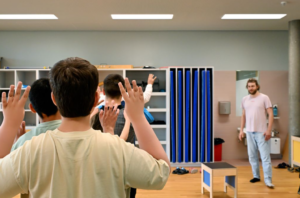
Students were encouraged to:
- engage with water as a process rather than an object
- reflect on environmental change through their own bodies
- develop movement-based responses to ecological questions
This approach created a direct and accessible connection between art, education, and climate awareness. By working with young participants, the project expanded its impact beyond the art context and into everyday learning environments.
Seeing Water Differently: Film as Reflection
In contrast to the ephemeral nature of performance, Hans Hofer approached water through film.
His project See Grund focuses on the Grundlsee, exploring how water shapes perception, landscape, and atmosphere in a natural environment.
Rather than documenting the lake in a conventional way, Hans Hofer developed a cinematic language that emphasizes mood, temporality, and subtle change. The film invites viewers to slow down and observe, highlighting details that often remain unnoticed.
Through this approach, water becomes not only a visual subject but an experience that unfolds over time.
Between Ephemeral and Lasting Experiences
LUL 3 is defined by the interplay between different artistic forms:
- the performances of Adrian Dorfmeister and Simeon Ohlsen exist only in the moment
- the film by Hans Hofer creates a lasting visual work
Together, they offer complementary ways of engaging with environmental themes, through direct, embodied experience and through reflective observation.
Participation and Public Engagement
Participation played a key role in LUL 3.
The project reached different audiences through:
- school workshops with students
- public performances in Seestadt Aspern
- film screenings and discussions
These formats, facilitated by the Wiener Bildungsakademie, created multiple entry points into the topic of water and environment.
By combining education, performance, and film, LUL 3 was able to engage both younger audiences and the general public.
Connecting Local Practice with European Exchange
The outcomes of LUL 3 were presented within the broader framework of turning the tide, linking local artistic practices in Vienna with international exchange.
Through the work of the Wiener Bildungsakademie, the projects of Adrian Dorfmeister, Simeon Ohlsen, and Hans Hofer became part of a European dialogue on climate, water, and artistic practice.
Why LUL 3 Matters
LUL 3 demonstrates that environmental awareness can be created through different forms of experience.
Through the works of Adrian Dorfmeister and Simeon Ohlsen and Hans Hofer, water becomes:
- physically experienceable through movement
- accessible through education
- visible through film
By connecting body, learning, and perception, Turning the Tide, together with the Wiener Bildungsakademie, shows how art can create deeper and more lasting connections to environmental processes.