Every map reflects its author.
This idea lies at the heart of our work as cartopologists. Just as an anthropologist inevitably becomes part of the research they conduct, a map is never entirely complete nor objective. It is shaped by the choices, experiences, questions, encounters and values of its maker.
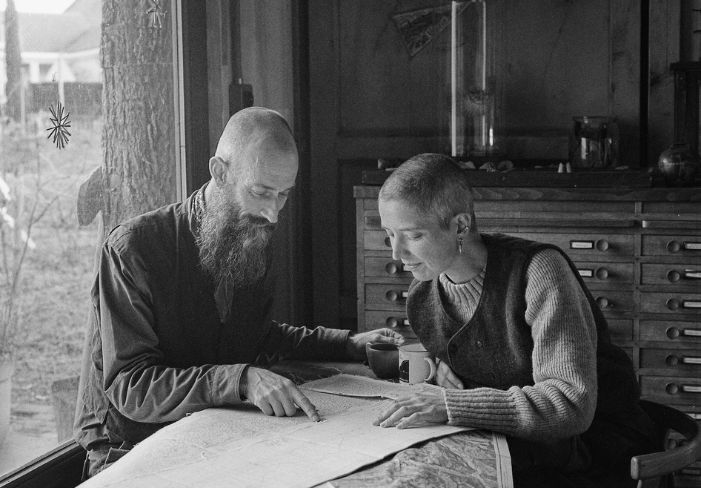
We are Marlies Vermeulen and Remy Kroese, founders of the mapping practice Dear Hunter and the Institute of Cartopology – Berghut Halverwege, an independent research and education institute based in a mountain hut in the border landscape where the Netherlands, Belgium and Germany meet. Together we work as map makers, educators and hut keepers. With backgrounds in architecture and art education, we bring both spatial expertise and anthropological depth to how we understand and represent our living environment.
Our own biographies inevitably shape the maps we make. Remy’s work as hut keeper ánd research lecturer at various art schools and universities keeps him both grounded in practice and attuned to academic reflection. Marlies, who founded the Institute for Cartopology in 2023 and completed her PhD in 2026, pushes the boundaries of mapping practices through the many projects initiated by the Institute of Cartopology. Living and working in the border region has taught us to think beyond political boundaries. Years of artistic research and mapping since we co-founded Dear Hunter in 2014 have made us attentive to ambiguity, complexity and multiple truths.
What is cartopology?
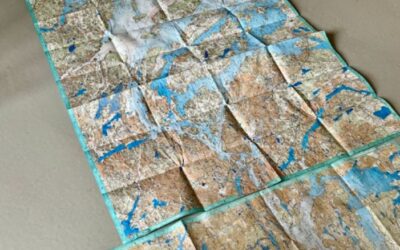
Cartopology is both the study and practice of mapping relationships that conventional maps often leave out. Rather than focusing only on physical geography, a cartopological map explores how people, landscapes, memories, ecological systems and histories are interconnected.
Unlike traditional cartography, cartopology does not seek a single objective representation of reality. Instead, it embraces multiple perspectives, acknowledging that every map is shaped by the person who creates it and by the people who contribute to it. Rather than simplifying, upscaling and summarising, cartopology tries to do justice to complex realities and different viewpoints. We believe that acknowledging the position of the mapmaker creates more honest, more transparent and ultimately richer forms of research.
It is rarely acknowledged nowadays, but every map begins with a person who decides what belongs on it and what does not. Those decisions are never neutral. They are shaped by experience, values, interests and imagination. That is why cartopology insists on making the mapmaker visible. Not because objectivity has no value, but because every claim to objectivity starts with human choices.
As long as we continue to treat maps as neutral mirrors of reality, we risk confusing a perspective with the lived reality out there. Cartopology tries to invite to do something different: to recognise maps as situated, relational and inevitably unfinished. In doing so, they become not weaker, but more honest. And perhaps that makes them better in facilitating a dialogue, rather then imposing a singular perspective.
Our work within Turning the Tide
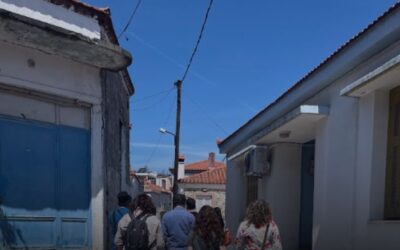
For us, Turning the Tide was an opportunity to practise cartopology in five very different landscapes and cultures. Within the project, we develop and guide collaborative mapping processes that invite participants to investigate these landscapes from multiple perspectives. Rather than starting with fixed methods or predetermined outcomes, we begin with curiosity. We basically do everything you’d do at home: hang around, meet people, run, walk our dogs, observe, listen, but we also draw, collect, interview and reflect upon what we’ve been hearing, doing, feeling. We somehow are resident, researcher and mapmaker at the same time.
The resulting maps, all combined within the Turning the Tide Atlas, are not intended as definitive representations of the places we visited. Instead, they capture relationships, observations, questions and experiences that emerged during the process. Together they reveal aspects of places and lives that are often difficult to measure but inevitable for their character and well-being.
© Photo credits: Ward Willems