The first Vienna Local Urban Lab (LUL 1) within the European cooperation project turning the tide, implemented by the Wiener Bildungsakademie, explored a central question: how can art make sustainability visible, relatable, and part of everyday urban life?
Set in Seestadt Aspern, one of Europe’s most innovative urban development areas, LUL 1 brought together two artistic positions that approach environmental awareness from very different, yet highly complementary perspectives: Anny Wass and Paul Kitzmüller.
Art as a Bridge Between Global Challenges and Local Life
Artist Anny Wass introduced a powerful visual and performative element into the urban landscape: a whale. As a symbol of ecological fragility and interconnected ecosystems, the whale connects global environmental issues, such as ocean pollution and climate change, with the lived reality of a local community.
Through public presence and participatory formats, Anny Wass invited residents to engage with environmental questions in an intuitive and emotional way. Rather than presenting abstract data, the project created a direct, physical encounter with the idea of sustainability.
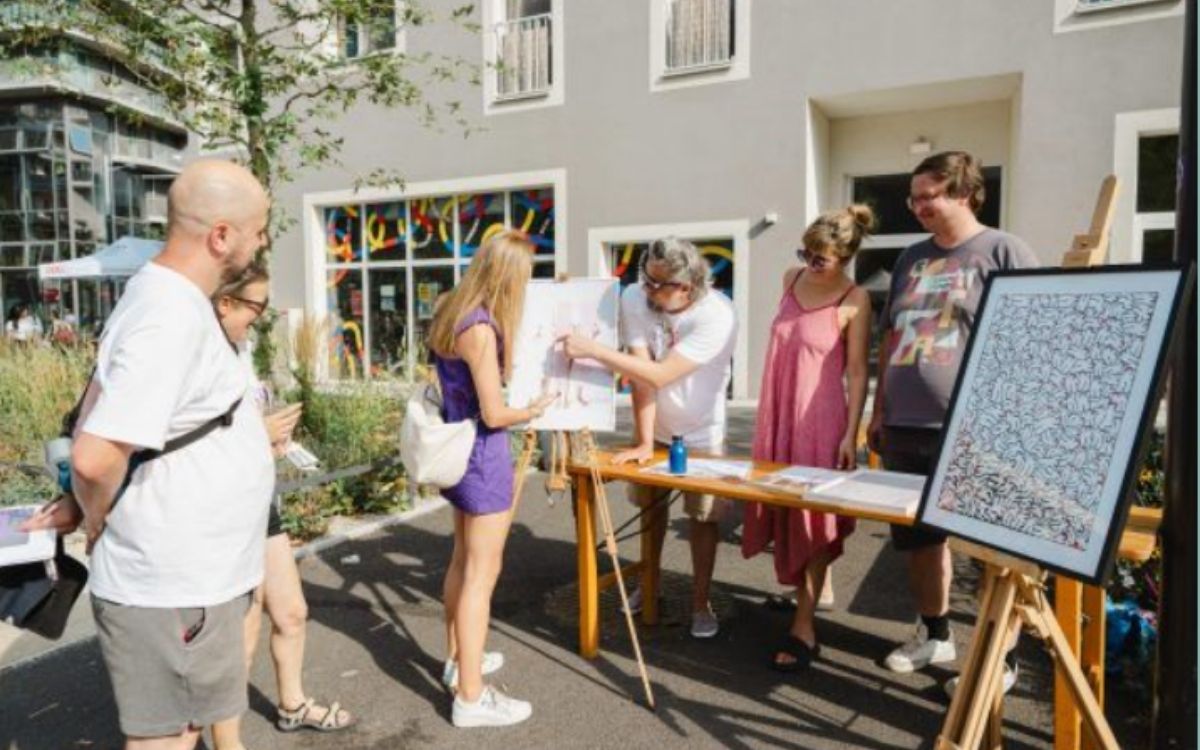
At the Seestadt street festival, where the Wiener Bildungsakademie and the Turning The Tide project engaged with a broad audience, this approach became especially visible. The work of Anny Wass functioned as an entry point for conversations, drawing in people who might not otherwise engage with climate discourse.
Visualising Community as a Living System
While Anny Wass worked with symbolic imagery, Paul Kitzmüller focused on the human dimension of sustainability.
His project, The Individual in the Diversity, translates the idea of community into a dense visual language. Thousands of hand-drawn figures come together in large-scale works, each representing an individual, yet only gaining full meaning as part of a collective whole.
Paul Kitzmüller’s work reflects a key aspect of turning the tide: sustainability is not only about environmental systems, but also about social relationships and shared responsibility.
During public presentations and exhibitions organised in collaboration with the Wiener Bildungsakademie, visitors, especially children, engaged with the work by searching for figures that resembled themselves. This simple act created a powerful connection between identity, community, and environmental awareness.
Participation as a Key Element
A defining feature of LUL 1 was its strong emphasis on participation.
Both Anny Wass and Paul Kitzmüller actively engaged with the public through:
- informal interactions in public space
- presentations and discussions
- participation in the Seestadt street festival
These formats, facilitated by the Wiener Bildungsakademie, created low-threshold access to complex topics and allowed sustainability to be experienced rather than explained.
Connecting Local Practice with European Exchange
The results of LUL 1 were presented during the Turning The Tide International Lab in October 2024, where the works of Anny Wass and Paul Kitzmüller were embedded in a broader European context.
Through the work of the Wiener Bildungsakademie, local artistic practices in Vienna were connected to international discussions on climate, water, and urban transformation.
Why LUL 1 Matters
LUL 1 demonstrates that art can play a crucial role in addressing climate challenges, not by simplifying them, but by making them tangible.
Through the works of Anny Wass and Paul Kitzmüller, sustainability becomes:
- visible
- participatory
- emotionally engaging
By connecting global environmental issues with everyday urban life, turning the tide, together with the Wiener Bildungsakademie, shows how artistic practice can foster awareness, dialogue, and meaningful change.