Turning the Tide: Stockholm Lab
Culture, Water, and the Power of Art in Times of Change
15–17 October 2025 | Stockholm, Sweden
In mid-October, Stockholm hosted a four-day event where art, culture, and environmental issues came together. Intercult brought together artists, cultural workers, urban activists, scientists, and policymakers to share ideas and work together.
Participants focused on how art and culture can help communities connect, cooperate, and bring about change.
“…the most important result of the Turning The Tide: Stockholm Lab was its contribution to solidarity with each other, empathy for and understanding of the different ways of living under the threats of climate change. Most important result as solidarity, the understanding of each other’s points of view, is the basis democracy or peace are built on. And important also because artists expressed their thoughts in the most common language in the world: the language of art.” – Eva Stache, architect from the Netherlands
Wednesday, 15 October – Art as a Drive for Social Change at VRAK – Museum of Wrecks
The day marked the official opening of Turning the Tide Stockholm Lab at the VRAK Museum of Wrecks, setting the tone for a dynamic exchange around art, water, and social transformation. The event opened with welcoming remarks from Iwona Preis, CEO of Intercult. We had the honour to welcome her Excellency Mag. Doris Danler, Ambassador of Austria in Sweden and her Excellency Ekaterini Fountoulaki, Ambassador of Greece in Sweden, who underlined the importance of international collaboration in cultural and environmental initiatives in Europe and beyond.
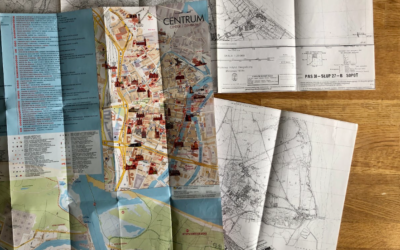
Throughout the day, participants engaged in a rich program of talks, panels, and artistic presentations. Experts from across Europe Lia Ghilardi, Johannes Tovatt, and Astrid Rompolt, shared insights on cultural and urban planning, water management. The conversation touched on many different aspects and highlighted how different approaches can work collaboratively for sustainable living. The Dutch duo Dear Hunter introduced us to their method, cartopology – a combination of cartology and anthropology – and presented their map of Stockholm, which is the outcome of their 6-week residency in the city. The programme was followed by artistic research and creative practices from Vienna, Gdańsk, Evia, Scotland, and Stockholm, which highlighted how art can inspire environmental awareness, foster community participation, and drive social change. Artists Gisela Stiegler from Austria and Celina Przyklęk from Poland presented their artworks that have been researched and produced during their one-month residency in Sweden, curated by Elisavet Papageorgiou from Intercult.
The discussions on climate and biodiversity, to participatory art and public space interventions, created a vivid demonstration of how creative approaches can shape more sustainable, inclusive, and resilient societies. The Turning the Tide Stockholm Lab thus began with an inspiring convergence of voices—artists, planners, diplomats, and cultural leaders—united by the shared belief that art holds the power to transform both people and places.
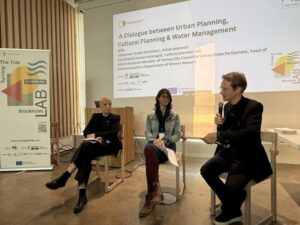
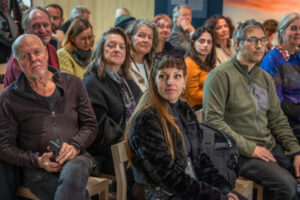
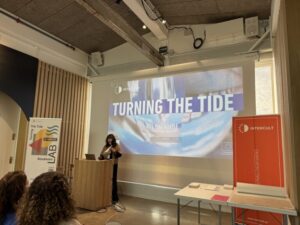
Thursday, 16 October – Water, Cities, and Sustainability at Kulturhuset, Foajé 3
On the second day of Turning the Tide Stockholm Lab, activities moved to Kulturhuset Foajé 3, focusing on the challenges coastal cities face in the context of climate change. The program highlighted urban resilience, water management, and innovative planning, blending expert talks, artistic contributions, and interactive discussions to explore strategies for building adaptable, future-ready cities.
A major highlight of the day was the art fair, featuring 15 works created within the European Turning the Tide project. The exhibition showcased a diverse range of artistic expressions—from installations and performance to visual storytelling—offering powerful and accessible reflections on water, resilience, and the urgent climate challenges our cities confront. Participating artists included Jenny Marketou, Tina Eskilsson, Ongoing Realities, Ludmila Christeseva, Vlady, Ajja, Zoe Lakides, Kasia Piorek, Celina Przyklęk, Gisela Stiegler, Froso Papadimitriou, and Kamila Chomicz.
This add-on event offered the opportunity to the artists to present their work, make new connections in Stockholm and internationally, and get a deeper insight into the project’s impact locally and internationally.
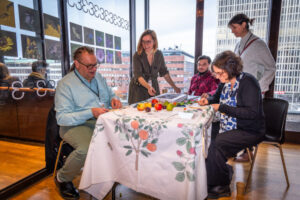
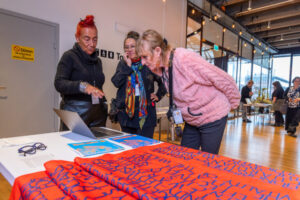
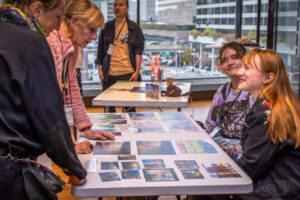 Photos from the art fair. Credits: Andrzej Markiewicz
Throughout the rest of the day, participants attended a series of presentations and panels. Topics ranged from Stockholm’s urban flood resilience strategies from Jonas Althage (Strategist, urban flood management City of Stockholm) to suggestions of how to move out of our social/professional/personal bubble (Emma Stenström, Associate Professor,Stockholm School of Economics and Co-Director of Center for Arts, Business & Culture),
The academic flow was “interrupted” by Marie-Andrée Robitaille (artistic director at Cirkus Cirkör) who introduced us to her innovative art intervention “Semaphores as Acts of Change,” an interactive performance that she developed during her local residency in Turning the Tide project back in the fall of 2024.
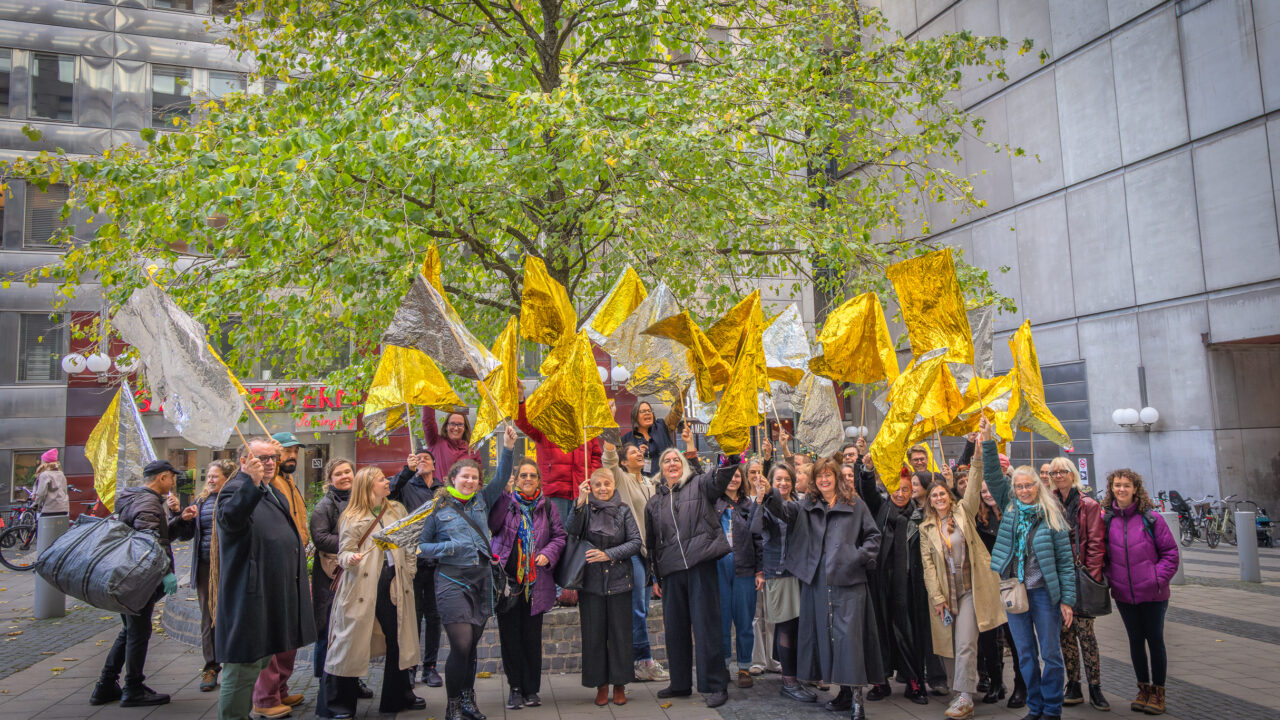
The performance included a public manifestation at Sergelstorg with handmade golden flags, allowing participants to experience firsthand how art can activate public space, provoke reflection, and foster community engagement around water and climate issues.
“To go out with these fragile, beautiful shiny flags…what a joy! And how strong we were, how committed, and how open our minds became. Sharing this pleasure, this strength, this power. It was a great experience” – Germaine Sanders, about Marie-Andrée Robitaille’s interactive performance
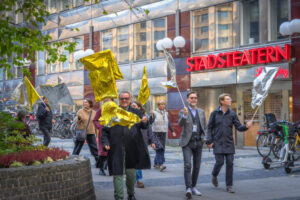
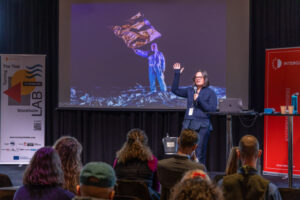 “Hope in Motion” Manifestation at Sergels Torg by Marie-Andreé Robitaille. Photo Credits: Andrzej Markiewicz
The day continued with an interesting roundtable discussion with experts in hydraulic engineering, architecture, and water governance. Thomas Rebermark (Director of Swedish Water House, Stockholm International Water Institute) invited Luigia Brandimarte (Associate Professor & Docent in Hydraulic Engineering, KTH Royal Institute of Technology), Marta Bohlmark (CEO & partner, Gaia Arkitektur) and Magnus Arnell (Programme manager, Water Wise Societies) to discuss on how to build Resilient Waterfront Cities, what are the challenges that scientists and experts are facing and how art could be a force to reimagine our cities.
Another highlight of this day was the free, unmoderated dialogue between Germaine Sanders and Jonas Althage, where we could see on stage how a dialogue between an artist and a scientist could seek solutions.
The day ended with Dear Hunter, who reflected on the outcomes of the day and connected it with their own map of Stockholm.
“My key takeaway: learning to live with water rather than against it is more than a symbolic value. But what values genuinely inform our daily choices, vision, and large-scale projects? That’s why initiatives like Turning the Tide are crucial: by bringing together creative voices, institutions and communities, they help us rethink the built environment, our relationship with nature, and our social responsibilities.”
Carlo Galluccio
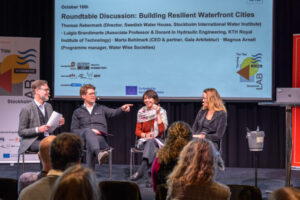
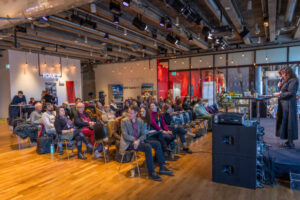
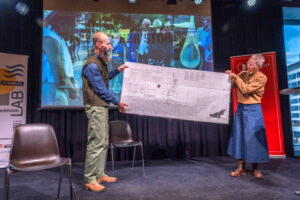 Photo Credits: Andrzej Markiewicz
Friday, 17 October – Future Visions: Turning Ideas into Action at VRAK – Museum of Wrecks & Stadsgårdsterminalen
The final day of Turning the Tide Stockholm Lab focused on looking forward—transforming awareness into concrete action. The program at VRAK Museum of Wrecks began with a lecture by Karim Jebari (Researcher, Institute for Futures Studies) on “The Future of Humanity,” providing a thought-provoking foundation for discussions on climate responsibility and societal change.
A roundtable discussion, “From Words to Action: Art, Activism, and Technology,” brought together Jebari, climate activist Pella Thiel, artist Belinda Retourne (Homo Colossus), Annika Bromberg (Hållbart Kultur Nu) and international artist Jenny Marketou, exploring how creative interventions, activism, and innovation can translate ideas into tangible solutions.
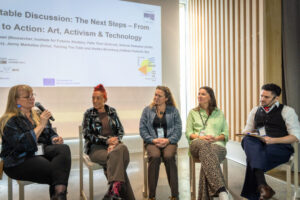
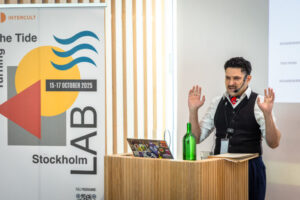
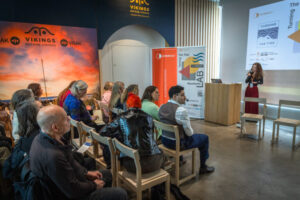 Photo Credits: Andrzej Markiewicz
The conference ended with reflections of the whole event – what have we learned and which are the next steps? – from Iwona Preis (CEO of Intercult). This dialogue was followed by a striking performance by the Austrian dance duo Adrian Dorfmeister-Pölzer & Simeon Ohlsen. While dancing in water within the museum hall, their performance captivated not only the Lab participants but also all visitors to the museum, creating a memorable and powerful artistic experience.
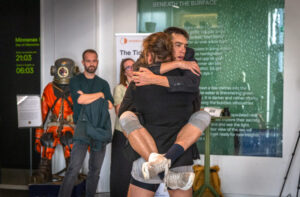
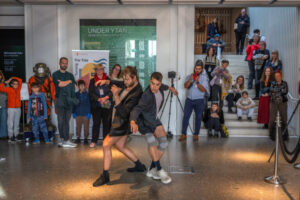 “Do you relate?” Performance by Adrian Dorfmeister-Pölzer & Simeon Ohlsen. Photo Credits: Andrzej Markiewicz
The day, and the Lab, ended with an evening exhibition at Stadsgårdsterminalen, featuring site-specific works by Jonna Bo Lammers and Agnieszka Stobierska. Both artists have developed site-specific works at Stadsgårdsterminalen that explore climate justice, urban development, and collective resilience. Jonna’s bold, colorful murals address social issues, while Agnieszka merges art, ecology, and civic imagination to transform public spaces into platforms for reflection and engagement. The artists presented their work and talked more about the background of their concepts while visitors admired their masterpieces on the walls and windows of the venue.
“Turning The Tide: Stockholm Lab was a reminder that change begins not only in policies or plans but in the imagination, in the fleeting, fragile moments when perception shifts. The residency’s workshops, performances, and encounters worked on multiple levels: conscious and subconscious, intellectual and emotional, personal and collective. They allowed participants to feel the complexity of living with water and climate, rather than merely discuss it. This, ultimately, is what Turning the Tide offers to Europe’s cultural landscape: a practice of seeing, sensing, and making meaning together across borders. It is not about providing answers but about cultivating attentiveness, to the river, to one another, and to the fragile systems that sustain us.”
Liz Gardiner, Fablevision.
Thank You
As we close this inspiring chapter, we would like to express our heartfelt gratitude to everyone who made this event possible.
Thank you to Creative Europe and Kulturrådet for their invaluable support in creating projects that champion sustainability, bring Europe together, and empower local action through collaboration. A special thank you to our local partners in Stockholm who helped make everything happen: Vrak – Museum of Wrecks for graciously hosting the event, and Stadsgårdsterminalen for hosting the final gathering and supporting our local artists Jonna Bo Lammers and Agnieszka Stobierska throughout the process. Our gratitude also goes to Kulturhuset for hosting our event on the 16th with such professionalism, and to Färgfabriken for welcoming our partners Dear Hunter during their six-week residency in Stockholm.
A huge thank you to our dear Turning the Tide partners—Wiener Bildungsakademie (Austria), City Culture Institute (Poland), Artit (Greece), Dear Hunter (Netherlands), Fablevision (Scotland), and River Cities Network (Austria)—for joining us on this remarkable journey of turning the tide together.
Thank you to all our partners, collaborators, and participants for your commitment, creativity, and shared vision.
Until next time, let’s keep turning the tide!