Looking Back on Three Years of Turning the Tide
Three years ago, partners from Sweden, Poland, Greece, Austria and the Netherlands began Turning the Tide with one question: what kind of world do we want to live in? Over the years that followed, the project brought artists, scientists, planners and residents together in Gdańsk, Vienna, Evia and Stockholm, four places shaped in very different ways by water and the climate crisis.
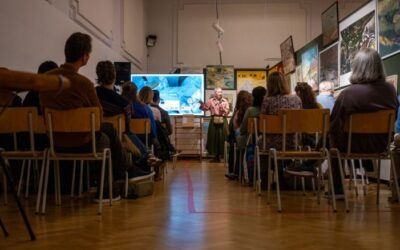
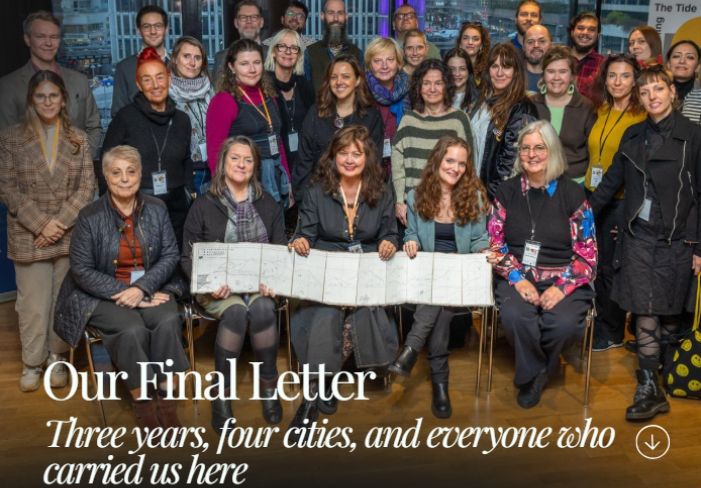
With the Final Conference in Maastricht and Vaals this October, Turning the Tide has come to a close. This article looks back at the journey as a whole: what we did, what each place taught us, what stays available to everyone, and the people we have to thank.
Three years, four places, 42 artists
The heart of the project was the Local Urban Labs. Between 2024 and 2026, four rounds of labs hosted by Intercult, Artit, the Wiener Bildungsakademie and the Instytut Kultury Miejskiej brought 32 artists into close contact with their own cities. They walked buried canals, worked with schools and neighbourhood groups, gathered testimonies from communities living with fire and flood, and created work with the people living the climate crisis rather than about them.
Alongside them ran the International Urban Labs: Gdańsk in spring 2024, Vienna in autumn 2024, Evia in spring 2025 and Stockholm in autumn 2025. Ten international artists joined residencies, site visits, lectures and roundtables with scientists, policymakers and local experts, testing one question from city to city: what can culture do in the face of the climate crisis?
Throughout, Dear Hunter carried out cartopological fieldwork in every location, listening to residents and mapping how each place lives with water. Their work became the Turning the Tide Atlas, launched together with the Digital Exhibition at the Final Conference in October 2026.
Four places, four stories
Each place had its own relationship with water, and each shaped the project differently.
Gdańsk is a city built between the Baltic, its rivers and its shipyards, with a long history of resistance and renewal. Much of its water is out of sight: buried canals run beneath the streets, and centuries-old locks quietly keep the city dry. Here, the labs focused on reading the city closely, with artists working alongside marine scientists, planners and residents.
Vienna offered a city still being built. In Seestadt Aspern, a new district rising around a lake, the labs asked how a growing city can make room for nature and how people can experience water as something tangible rather than abstract. Schools, families and passers-by took part through workshops, performances and public events.
Evia brought the hardest question: how can culture help a place heal? Still living with the 2021 wildfires and the floods that followed, local communities shared their stories, losses and hopes. It was in Evia that the Local and International Labs met for the first time, culminating in the Íchni exhibitions in Chalcis and Piraeus.
Stockholm, a city built almost entirely around water, where the land itself is slowly rising from the sea, took the project into public space. Through festivals, squares and a working harbour terminal, thousands of people encountered the work without planning to, and climate justice became a conversation held on the street.
What remains
The project has ended, but its results remain open to everyone.
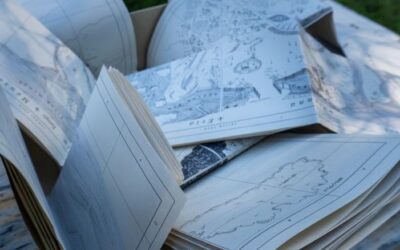
The Turning the Tide Atlas gathers three years of cartopological fieldwork by Dear Hunter. Its five hand-drawn maps of Gdańsk, Vienna, Evia, Stockholm and the Euregio Meuse-Rhine, and a cross-section map that reads them against one another, show how differently each place lives with water. Built from the voices of residents, scientists and planners, it invites readers to look differently and question their assumptions.
The Digital Exhibition brings together the work of all 42 artists, 10 international and 32 from the Local Labs. Instead of starting with the artists, it starts with the places, asking why each work was made where it was, whose knowledge entered it, and what changed once artists joined the conversation.
The Artists Interviews Publication gathers reflections from the artists themselves: how the climate emergency is reshaping their practice, what it means to create in places marked by flood, fire and rising water, and whether art can do more than document a crisis. The result is an open, honest look at art on the front line of climate change.
All three are available through the project website, the partners’ websites and the River//Cities platform.
With thanks
Turning the Tide was built by a consortium of Intercult (Sweden), Artit (Greece), the Wiener Bildungsakademie (Austria), the Instytut Kultury Miejskiej (Poland) and Dear Hunter (the Netherlands), in collaboration with Fablevision and River//Cities. We thank every partner for three years of trust, patience and shared work across borders.
Above all, we thank our 42 artists, who stepped into unfamiliar places, met each community with curiosity and care, and turned what they heard into installations, films, performances, sound works, maps and murals. Their work is the heart of everything the project leaves behind.
We also thank the scientists, researchers, planners and experts who answered the artists’ questions, the hosts who opened their doors, and the young people, families, neighbours and local groups who joined a workshop, a walk or a conversation and made these labs their own. Finally, we thank the European Union, through Creative Europe, for supporting culture as part of the response to the climate crisis.
Conclusion: the tide has turned
When Turning the Tide began, the question of what kind of world we want to live in felt almost too big to answer. Three years later, we have not found one answer, but many partial ones: a buried canal walked again, a community that told its own story of fire and flood, a square where strangers stopped to talk about climate justice, a set of maps that let five very different places learn from each other.
Perhaps the most important result is a way of working. Artists listening before making, scientists and residents sitting at the same table, institutions in five countries learning to see through each other’s eyes. That way of working does not end with the project. It continues in the partners’ programmes, in the artists’ practices and in the places where the labs took root.
A tide never really ends. It pulls back, and the shore it leaves is never quite the same. Turning the Tide has come to a close, but the questions it raised, and the people who asked them together, are still here.
Thank you for following our journey.
Want to keep exploring? Visit the Atlas, the Digital Exhibition and the Artists page, and discover the project at your own pace.