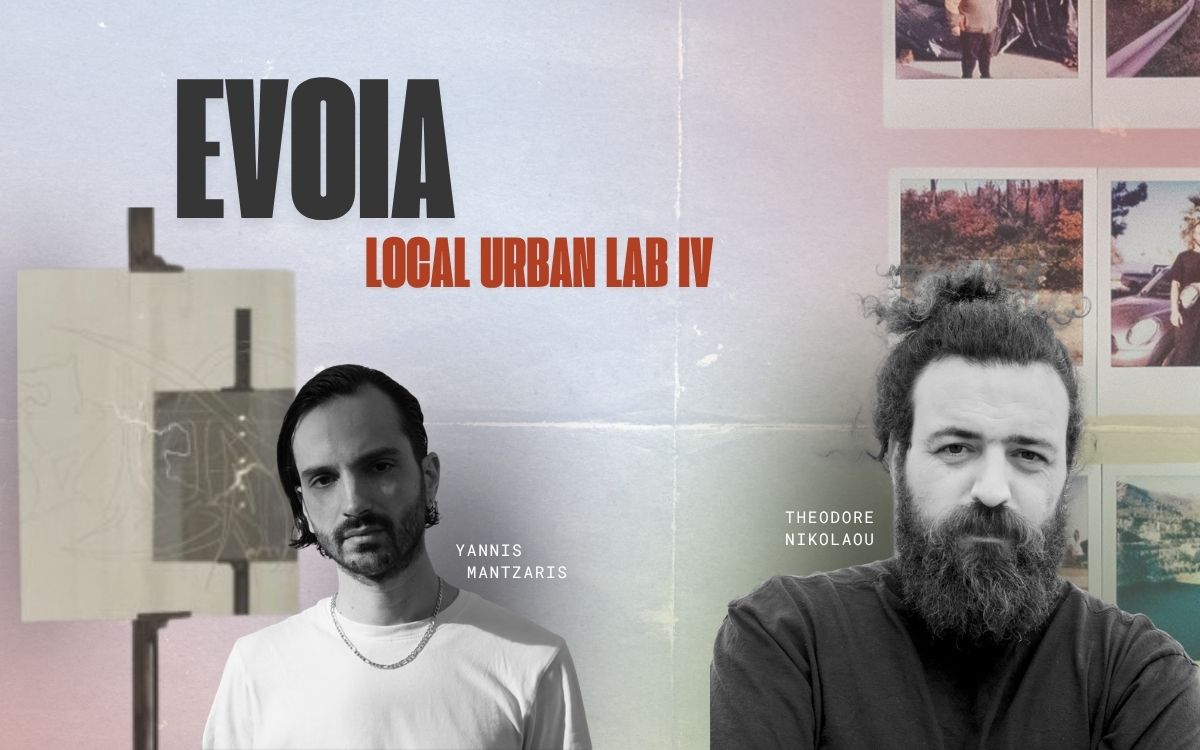
For the fourth and final round of the Evoia Local Urban Lab, two artists arrived at the same question from opposite directions: How does a place hold onto what’s happened to it?
Thodoris Nikolaou grew up in Chalkis, close enough to Northern Evoia that the wildfires and floods were never abstract to him. Yannis Mantzaris came to the island differently, drawn by a quieter fascination with how politics and infrastructure carve up the spaces we share.
Over a three-month digital residency, the two worked apart but never far from each other’s thinking, and what they brought back sits together almost like two halves of the same gaze, one crouched close to a single family’s daily life, the other standing back to take in an entire, contested sea. The residency gave them room to sit with that uncertainty for a while rather than rushing past it, and something in the slowness seems to have mattered. By the time each project found its footing, it had the kind of patience that only comes from not forcing an answer too early.
Theodore’s project, Ancestors, moves through fire and aftermath toward something more tender. The early chapters draw from his own archive, the disaster as it happened and the scarred land it left behind, before slowing into a series of Polaroid diptychs that sit with the strange intimacy between people and the land that has hurt them and been hurt by them in turn. But it’s the final chapter, Twins, that really anchors the work. It took him to Kastri, a remote village in the north, where he found siblings Marianiki and Christos Kouvelis. Rather than photographing them himself, he gave them the camera, really, just their own phones and let them tell their village’s story from the inside. He stayed close, mentoring from a distance, but the images themselves belong entirely to them.
There’s something quietly radical in that choice, to make a project about a place by stepping back and letting two teenagers decide what mattered enough to point a lens at. The photographs that came back aren’t polished or composed the way a professional’s would be. They’re full of ordinary things: a kitchen table, a dog asleep in the heat, the particular light of a Kastri afternoon. And maybe that’s the point. A village survives in those details as much as in the scorched hillsides around it.
Yannis spent his residency out on the water, listening to scientists, fishermen, and activists describe a gulf far more divided than it looks: protected meadows, contested fishing rights, and a shelved plan for floating solar panels. The more he listened, the less the Evoikos Gulf resembled a single body of water and the more it became a patchwork of overlapping, often invisible claims, boundaries that exist only on paper, or in someone’s memory of where the fish used to be. What emerged was Scarring Boundaries: Renegotiating the Surface, an installation of mirrors, steel, and salt, each mirror holding a fragment of a map or a testimony. Standing in front of it, the gulf stops feeling like a fixed place and starts feeling like something alive, something still being argued over.
Both works found their first audience at Íchni II, a group exhibition paying tribute to all of Evoia’s Local Urban Labs artists in Piraeus. For the first time, all ten artists who have passed through the Evoia Lab across its three cycles stood in the same room, Theodore and Yannis alongside Christina Maridaki, Giorgos Gerontides, Angela Liosi, Maria Gouveli, Froso Papadimitriou, Eleni Vrettakou, along with the artists participating in the International Labs, Jenny Marketou and Eva Andronikidou. Years of work made separately, in different seasons and different states of the island’s recovery, suddenly hung side by side. Piraeus, a city that has always defined itself by the sea, gave the gathering its own quiet charge, carrying Evoia’s story somewhere it could meet entirely new audiences.
The Evoia Lab closes here, but a place like this one was never going to fit neatly inside an ending; it just keeps finding new hands to carry it forward.
Don’t forget to explore Thodoris’s and Yannis’s work in more detail!